
Fiona Taylor is a Humanities and Geography teacher at Coburg High School, a local resident and a member of the Merri Birdies, one of the WaterWatch groups along the Merri Creek.
What’s your favourite spot on the Merri Creek?
There are too many to choose! One I love is where we do the Merri Birdies and WaterWatch monitoring with our Coburg High students, opposite De Chene Reserve. It’s quite enclosed under the trees, and the sound of water flowing over the rocks is so peaceful. I also love riding along the track, especially in drizzly rain. I always arrive in the best mood after riding along the creek.
Favourite time of year?
I love spring – the cygnets and ducklings and the wattle and eucalypts flowering, seeing deep into the creek, inspecting the fish and creek bed.
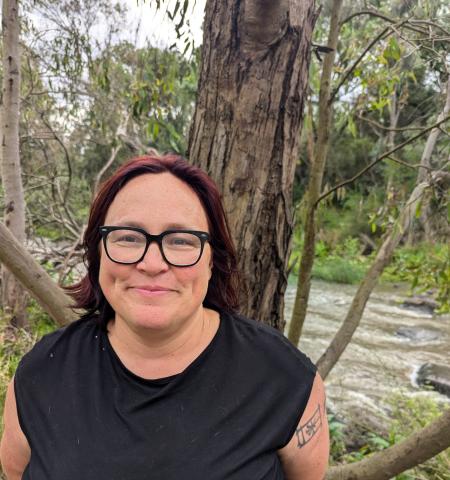 Fiona Taylor, member of WaterWatch group the Merri Birdies and teacher at Coburg High School.
As Merri Creek Management Committee completes its 35th year of protecting and restoring the Merri Creek, we enter a new organisational chapter, with the departure of former Manager and hugely influential Merri Creek advocate and devotee, Luisa Macmillan. While Luisa completed her Manager role in August 2023, we have continued to benefit from her expertise and experience through a part-time role as Manager, Special Projects, which concluded in October.
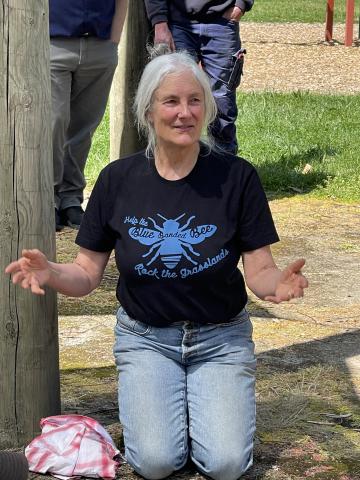 Luisa Macmillan, who led MCMC for over 21 years.
As Harry White spent the day walking along a long stretch of the Merri Creek lined with big, old red gums and listening to the trickle of water over rocks, he reflected on the joys of working on Wurundjeri Country.
“We were searching for weeds like Chilean Needle Grass, but as we walked, we spotted some Growling Grass Frogs – which hadn’t been seen in that part of the creek for several years – and a Sacred Kingfisher. It was really special.”
At the time, Harry was a Melbourne University student, fulfilling the work placement requirements of his Masters of Ecosystem Management and Conservation at Melbourne University, under the guidance of MCMC’s Ecological Restoration Program Coordinator Chris Geary.
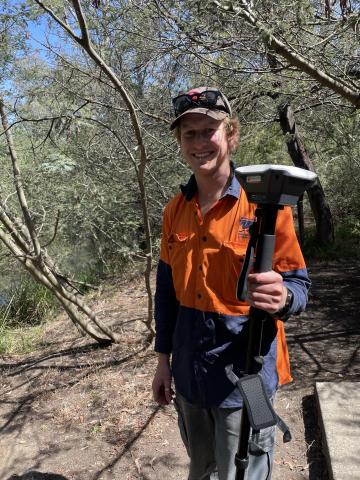 Harry White, MCMC Ecological Restoration Team and former Melbourne University student.
The Krefft's Glider, one of Australia’s most endearing nocturnal marsupials, is a master of the night. With large eyes and thick grey fur, these tiny mammals can glide distances of 50 metres or more, spreading their limbs to expose soft membranes – known as patagia – and traversing from tree to tree under the cover of darkness.
Thanks to this remarkable soaring ability, Krefft's Glider (previously known as the Sugar Glider) rarely descend to the forest floor. Living in small social groups, they nest in tree hollows lined with fresh gum leaves – a characteristic marker of their presence.
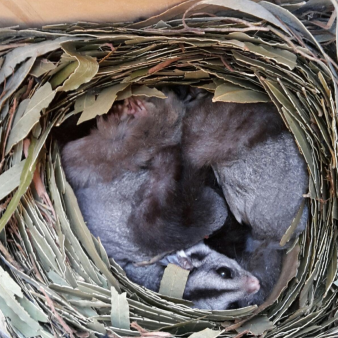 The distictive, clean nest of a Krefft's Glider (Petaurus notatus). Photo by Chris Cobern, MCMC.
In July, Landcare Victoria awarded Merri Creek Management Committee winners of the 2024 Australian Government Community Partnerships Landcare Award. This award acknowledged our work over 35 years, transforming the Merri Creek from a weed-smothered drain to a much-loved waterway running through a picturesque bushland corridor together with our many volunteer and Friends-of groups. We thank the many people that have been part of this ongoing journey and who continue to love the Merri Creek through their volunteering, their advocacy, their donations and their support.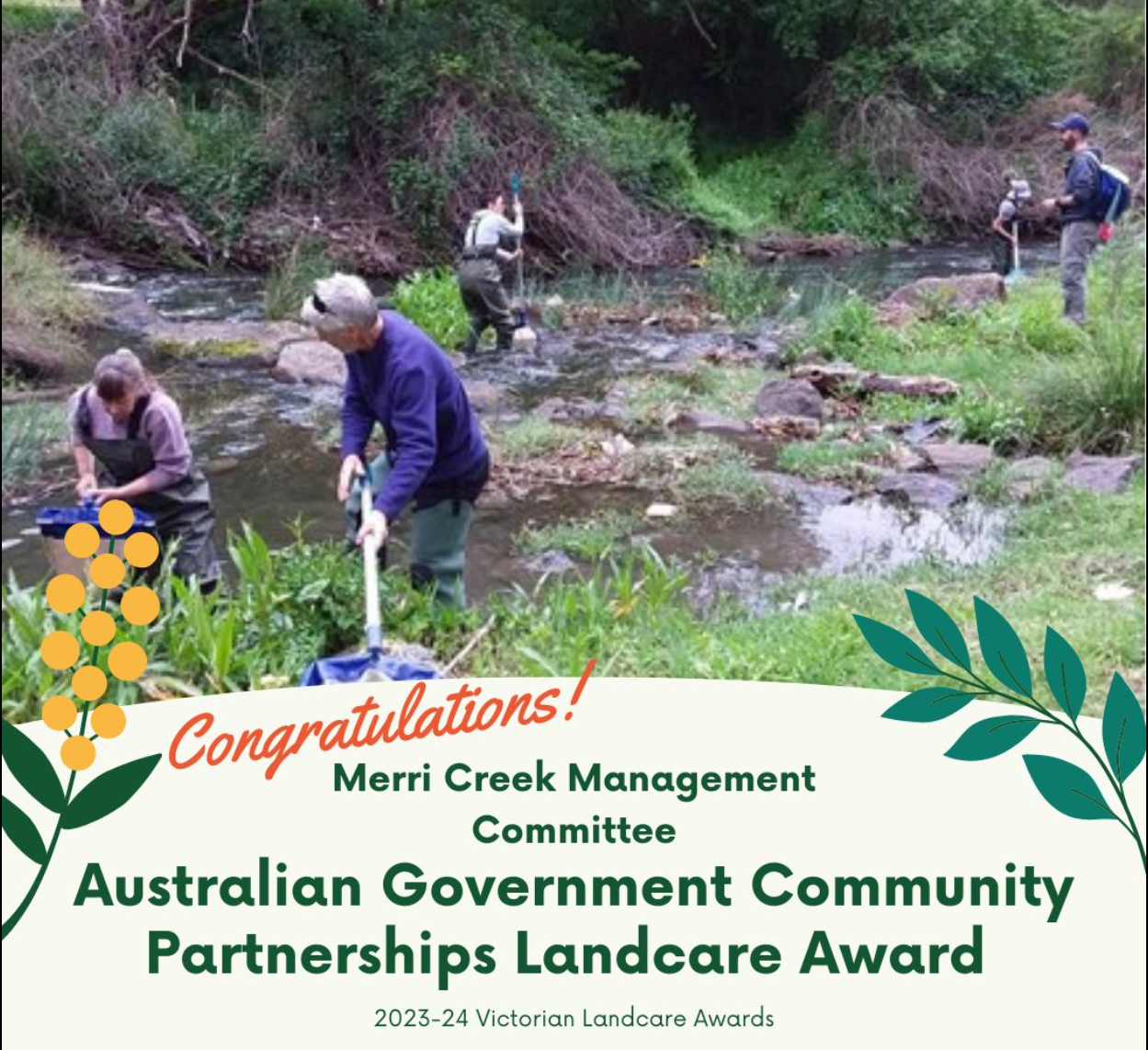
The awards received a record number of 146 nominations over 16 categories. We congratulate all nominees and award winners, including our friends at Darebin Creek Management Committee (DCMC) together with Narrap, the natural resource management unit of Wurundjeri Woi-Wurrung Cultural Heritage Aboriginal Corporation who we work with regularly. Narrap and DCMC won the First Nations Landcare Collaboration Award in recognition of their knowledge sharing and skills exchange with other community organisations.
Merri Creek Management Committee now goes into the National Landcare Awards, which will be announced in June 2025.
The wattles of the Wurundjeri season of Guling were bursting into colour as fourteen members of the newly formed Friends of Bracken Creek put down their trowels and trays of tube stock to pick up tools they were far less familiar with – pencils and paper.
“Some people were a bit reluctant at first,” says group founder Melanie Del Monaco. “They thought they couldn’t draw.”
The sentiment is a familiar one to environmental educator Angela Foley from Merri Creek Management Committee, who facilitated the learning and is used to giving participants time to recognise themselves as both artists and scientists.
“I meet people all the time, whether they are six or 60, who think that artists are a different kind of people,” says Angela. “But drawing is about being observant. Your drawing is data – a record of what you observed of a specific plant at a specific day and time.”
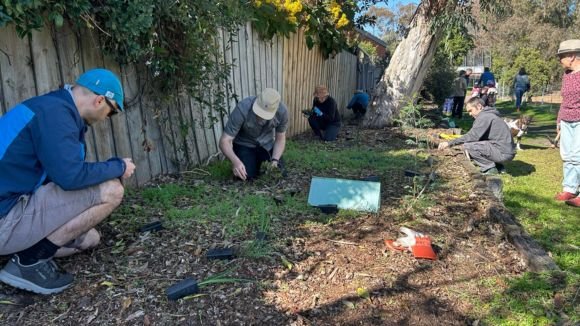 Friends of Bracken Creek planting day, along the Merri Merri in Northcote
In the early hours of a Melbourne morning, Danny Reddan can be found running a ten-kilometre route along the urban waterways of his inner-Melbourne neighbourhood. As he rounds the stretch of trail that takes him past the Moomba Park Wetlands, his mind turns to the Growling Grass Frogs he knows are busying themselves nearby.
“Growling Grass Frogs just remind me of my childhood in Warrnambool,” says Danny. “I was always out chasing frogs and lizards and so I have an idea of what habitat on the Merri Creek and its tributaries would once have been like – and what they could be like again too, if we work hard enough, if we come together as a community.”
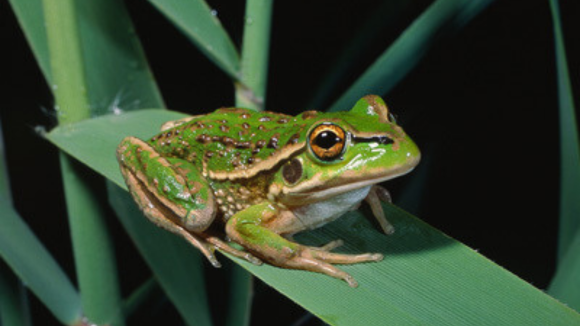 Growling Grass Frog (Litoria raniformis), photograph by Geoff Heard
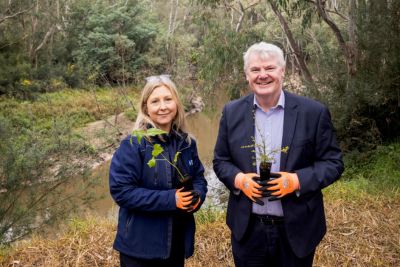 Vix Penko (Melbourne Water) and Shaun Leane MP
After 25 years living in Melbourne, Victoria Penko couldn’t imagine the city without the Merri Creek.
“Well, there’s no Melbourne without the Merri Creek, is there?” she laughs. As Head of Waterway and Catchment Services North West for Melbourne Water, Victoria describes Merri Creek Management Committee as “a pioneering trail-blazer in collaborative waterway management”. With these sentiments in mind, it was a “no-brainer” to rejoin as an MCMC member organisation last month, an announcement which MCMC President Ann McGregor describes as “a very welcome move.”
Merri eNews talks to Claudia James, President of the Wallan Environment Group. Tributaries of the Merri Creek (Wallan, Taylors, Mittagong and Stathaird Creeks) run through the growing town of Wallan, on the northern edge of suburban Melbourne, where Claudia James has led the group since 2016.
How is caring for waterways in Wallan different from other parts of the catchment?
Rapid urban development is our greatest challenge. Much time is spent advocating for the protection, extension and connection of public open spaces aligning the creek lines. As new subdivisions arise there is also the need to advocate for the protection of valuable remnant vegetation and natural wetlands, along with the connectivity of habitat for native species. Another point of difference is that the Merri tributaries mainly flow through private property in Wallan – only short, disconnected stretches of Wallan, Taylors and Mittagong creeks are accessible to the public. This means that advocating strongly for the best planning outcomes, at both local and state government levels, for the Merri Creek is really important.
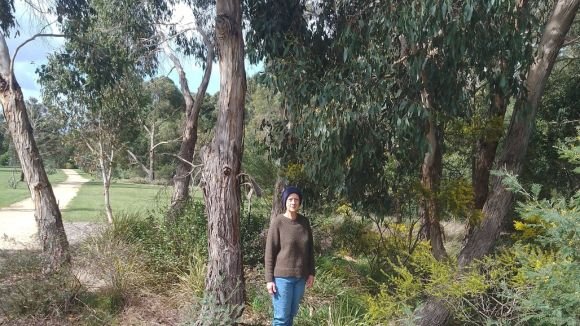 Claudia James, President of the Wallan Environment Group
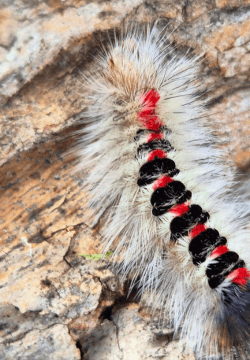 Long-tailed Bombyx (Trichiocercus sparshalli), photograph by Nayt Housman
Take a walk on the Merri Creek this time of year and you’ll notice the changes that have guided generations of Wurundjeri Woi-wurrung people through the season of Porneet – tadpole season. During Porneet (normally observed in the months of August and September) Pied Currawongs can be heard calling, Grass Candles begin to respond to the warmer temperatures and longer daylight hours, and tadpoles begin to wriggle their tiny tails in their wetland homes.
The first thing that Merri Creek Management Committee’s Nayt Housman notices as Porneet approaches is the dragonflies darting among the grasslands. Nayt is a member of our “bush crew” or Ecological Restoration team, which spends its days caring for the landscapes that hug the banks of the Merri Creek and its tributaries. In rain, hail or shine, Nayt has observed the Merri’s plants and animals for four years, including two as a volunteer and the last eighteen months as a bush crew member.
“The invertebrates are the first to notice the early changes in season,” says Nayt. “You see lots of amazing caterpillars this time of year.”
More Articles …
- Design award win for marram baba Merri Creek Parklands signage
- Golden hour: a surprise visitor to Merri Creek
- The boy who loved frogs
- How one woman helped to grow a nature-loving community
- My place: Jane Miller
- Healing Country at Amberfield Grasslands
- Waring on the Merri
- A vision for the future of marram baba Merri Creek Parklands
- Merri Creek and National Sorry Day
- In the darkness, the call of the Growling Grass Frog can surprise you...
Page 7 of 17
Merri Events Calendar
09:30AM - 11:30AM
FoMC Coburg Lake & Surrounds - Wednesday Working Bee
10:00AM - 11:30AM
MCMC: Connecting Kids with Birrarung's Creatures
10:00AM - 11:30PM
MCMC: Platypus, People and the Birrarung: Making Peace with Change
09:30AM - 11:30AM
FoMC Coburg Lake & Surrounds - Friday Working Bee
10:00AM - 12:00PM
FoMC @ Northcote Gorge - Weeding and Litter Pickup Event
10:00AM - 12:00PM
FoMC @ Edgars Creek - Maintenance Event
10:00AM - 12:00PM
MCMC: galgi ngarrk - walk and talk
04:30PM - 06:30PM
MCMC: Searching for platypus: Platy Project dusk walk at Birrarung and the Merri at Dights Falls
09:30AM - 11:30AM
FoMC Coburg Lake & Surrounds - Wednesday Working Bee
09:00AM - 10:30PM
MCMC: Beveridge bird walk & bird count



Connect on Social Media |


 Merri Creek Management Committee. 2 Lee St, East Brunswick, Victoria, Australia 3057 (view map in new window )
Phone:(03) 9380 8199 Email: ABN: 13 025 599 242
© Merri Creek Management Committee