
Standing on a low bridge over Merri Creek at galada tamboore, the assembled group falls quiet. With eyes closed, the landscape begins to separate into layers: water moving below, a gentle breeze through the beal (River Red Gums), birds calling overhead. Each person hears something different.
It’s November, in the Wurundjeri Woi-wurrung season of buath garru, when grasses flower across the landscape. In the surrounding grassland, seed heads are already forming, shifting between pale green and sandy gold as they catch the light.
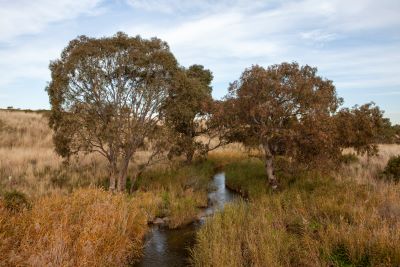 marram baba Merri Creek Parkland, image by Dianna Wells.
The group is taking part in a guided walk through marram baba, a newly established regional park in Melbourne’s north, led by MCMC’s Angela Foley. Participants are invited to experience the landscape through the lens of Wurundjeri Woi-wurrung seasonal knowledge – where time is marked not by calendar dates, but by what is happening on Country.
On this occasion, Angela is joined by Gunditjmara artist and educator Aunty Karen Lovett, who shares her own Aboriginal knowledge and perspectives alongside the walk. She brings along possum skins to show the group, along with clap sticks to help guide respectful conversation.
For Aunty Karen, that moment on the bridge – simply standing still and listening – is the most powerful part of the day.
“You actually get to listen to the creek running, and the wind in the trees,” she says. “Stuff that you don’t do every day. If it had been a nice day, I actually would have asked them to take their shoes off and felt Country, but it was a bit too cold for that.”
In place of four fixed seasons, the seven Wurundjeri seasons are grounded in observation. In buath garru (November), flowering grasses signal a shift into a warmer, often wetter time. By biderap (January–February), heat and dryness take hold, and the basalt soils crack open. In iuk (March), cooler conditions return and adult iuk (Short-finned Eels) begin their migration downstream.
Seen this way, the landscape becomes a living calendar: one that can be read through what is visible, audible and changing.
For Angela, this begins with paying attention. Rather than relying on dates, she looks for seasonal cues in the landscape itself: grasses seeding, trees flowering, animals moving through their cycles. “You can look for an indicator that makes sense,” she says. “It’s actual evidence in front of your eyes.”
A vast and varied landscape
At marram baba, those changes unfold across a vast and varied landscape. Spanning more than 2,700 hectares across Melbourne’s north, the parklands follow a 34-kilometre stretch of Merri Creek through grasslands, waterways and pockets of remnant vegetation. It is not one continuous park, but a mosaic of public and privately owned places – some familiar, others less visited without guidance.
That sense of discovery shapes the guided walks. Participants are often taken into quieter areas and encouraged to slow down, noticing details that might otherwise be missed.
A slower pace
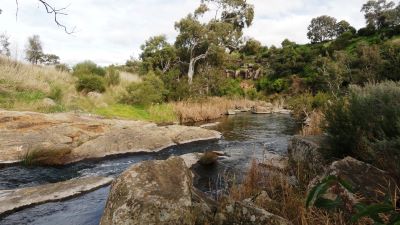 Merri Creek at galada tamboore.
At galada tamboore, the group moves at an unhurried pace. For Aunty Karen, who uses a walker and portable oxygen, that pace is essential – but it also influences the experience for everyone else.
“It’s exceptional when you get a whole group of people from different backgrounds. People are quite happy to walk at a slower pace,” she says. “And just be together in that space, observe, and listen to what’s happening around them.”
That act of listening is intentional. Participants are invited to pause, close their eyes, and focus on what they can hear. What follows is often surprising.
“People will say they heard birds,” Angela says. “And then you ask, how many kinds? One, two, three – and more hands keep going up.”
Through this way of seeing and listening, seasonal change becomes easier to recognise. What might once have seemed like a dry, lifeless stretch of summer – grass browned off, soil cracked open – reveals itself differently. Those fissures offer refuge for insects and reptiles, sheltering them through the hottest months. What appears still is, in fact, full of movement.
For MCMC, these seasonal rhythms also shape how work happens across the catchment, from restoration to community engagement. But just as importantly, they offer a way for people to build a more personal connection to place.
Back on the bridge, the group lingers for a moment longer. The creek moves steadily below. Somewhere in the trees, a Golden-headed Cisticola calls, and then another. It’s a small shift, but an important one: learning to notice what is already there, and to understand it as part of a landscape that is always changing, season by season.
Upcoming walks:
Tuesday 14 April 6:00 - 7:30pm marram baba at Kalkallo Common
Sunday 3 May 9.30am – 12 noon marram baba at galgi ngarrk
To find out about future giuded walks at marram baba, follow us on Instagram, Facebook, or subscribe to our events newsletter.




 Merri Creek Management Committee. 2 Lee St, East Brunswick, Victoria, Australia 3057