
On a crisp, frosty July morning, ecologist Annett Finger stood with her border collie Atticus in the grasslands around Curly Sedge Creek, taking in a landscape that felt almost magical.
“There were kangaroos, wallabies and deer, and everything was frozen,” Annett remembers. “It was very special to be there, a bit like opening a storybook.”
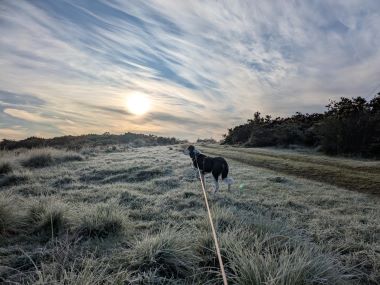 Atticus at galgi ngarrk, by Annett Finger.
For Atticus, though, the environment presented a challenge. Annett had brought her energetic conservation detection dog to galgi ngarrk (formerly known as Craigieburn Grasslands) to search for the critically endangered Matted Flax-lily (Dianella amoena). But with the grass carrying the scent of kangaroos, wallabies and deer, there was an awful lot competing for his attention.
A year ago, our Merri eNews introduced MCMC supporters to Annett and her self-described “pocket rocket”, when the pair were still in the early stages of training. The hope was that Atticus might eventually use his extraordinary sense of smell to find Matted Flax-lilies that are notoriously difficult for human surveyors to spot.
Now we have an answer: he can.
The nose knows
Across four survey days, Annett and Atticus, supported by volunteers Katie and Jordan, detected 77 colonies of Matted Flax-lily and one colony of the critically endangered Arching Flax-lily.
For comparison, an MCMC survey covering the same general area in 2012 detected around 10 Matted Flax-lily colonies, although that survey was conducted by two people over just one day and was therefore much less intensive.
The result rewards months of disciplined preparation. After learning how to imprint Atticus on buried odours, Annett made “pucks” using Matted Flax-lily root material and soil from the grassland. Training progressed from finding pucks in pots, to finding them on the ground and buried, and eventually to identifying whole plants.
The biggest test came when Atticus moved from individual plants to entire grasslands, where scent concentrations were very different.
“I knew he was ready when he started finding clumps that I had missed,” Annett says.
Even so, the first morning at Curly Sedge Creek was slow. Atticus was distracted by wildlife scents and Annett initially wondered how successful the search would be. But as the sun warmed the site and they moved into an area where several flax-lilies had previously been recorded, everything changed. They found 13 new locations that afternoon alone.
“That was when I realised we were going to end up with far more locations than originally thought,” Annett says.
Gotcha!
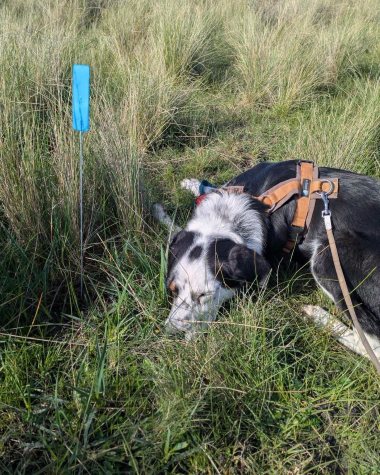 Atticus signalling his detection, by Annett Finger.
When Atticus detects a target, his first signal is the “gotcha face”, a quick turn of his head towards Annett. Asked to show what he has found, he lies down with his nose pointing towards the plant.
At one location, however, there was no plant to see. Matted Flax-lilies can be completely dormant during winter, leaving open the intriguing possibility that Atticus detected rhizomes below ground. The location has been recorded so MCMC can return in to see whether anything emerges.
For MCMC Program Officer Kirby Medway, the survey provides valuable new information about just how extensively Matted Flax-lily occurs at the site.
“It is reassuring because that’s an area we’ve started to shift our work into,” Kirby says. “It’s nice to know that there are a lot of high-value species there that hopefully our work will help conserve and create a better environment for.”
Those benefits extend beyond the flax-lilies themselves.
“The more time we’ve started to spend in that particular area, we’ve realised how diverse it is in terms of native species,” Kirby says. “It’s nice that, by proxy, they’ll receive that protection as well.”
MCMC’s work at Curly Sedge Creek includes controlling gorse and other invasive plants and the importance of those efforts became very apparent to Annett as the survey team navigated around dense patches of gorse and briar rose.
What lies hidden beneath?
“We were thinking, what is hidden under the bushes? Could they be masking even more native flora?” she says. “It just shows how important it is that MCMC does go in there and cuts back the weeds.”
Last year’s Atticus story was published as part of MCMC’s fundraising campaign for Curly Sedge Creek. The generosity of supporters like you, helps make conservation work in this special place possible – from controlling invasive weeds to trialling innovative new ways of finding and protecting threatened plants.
And the more time people like Annett, her volunteers and our restoration team spend at Curly Sedge Creek, the more its ecological value becomes apparent.
“My volunteers and I just couldn’t get over how beautiful it is there,” Annett says. “It just felt so special to be in this place.”
Find out more about Atticus and Annett’s work at atticusecology.com.au.




 Merri Creek Management Committee. 2 Lee St, East Brunswick, Victoria, Australia 3057